
Calorie Tracking for Runners: Eat Enough to Train, Still Lose Weight
By Kaelo TeamUpdated
A runner needs maintenance calories plus what training burns, with carbohydrate scaled to how much you run: about 5–7 g per kg of body weight a day for around an hour of training, and more for bigger weeks. You can lose weight while running, but only with a small deficit, timed away from hard sessions and races. Eating too little for long periods harms both performance and health.
 Download Kaelo
iPhone and Android. Snap a meal, get calories and macros in seconds. Free trial on the yearly plan.
On your computer?Point your phone's camera at the code to install Kaelo.
The practical answer
| Training load | Carbohydrate a day (ACSM) | For a 65 kg runner |
|---|---|---|
| Light / skill sessions | 3–5 g per kg | 195–325 g |
| About 1 hour a day, moderate | 5–7 g per kg | 325–455 g |
| 1–3 hours a day, moderate to hard | 6–10 g per kg | 390–650 g |
Protein of about 1.2–2.0 g per kg a day covers recovery. Calories are what's left once carbohydrate and protein are in place.
The problem
Runners usually make one of two mistakes. Some eat the same amount on a 20 km day as on a rest day, so long runs feel terrible and recovery drags. Others count running as a licence to eat and wonder why the weight doesn't move. Without a log of both runs and food, neither is visible.
What it costs you
- Under-fuelling. Flat sessions, slower recovery, getting ill more often, and — if it goes on — the hormone and bone problems described as RED-S.
- Over-estimating the burn. A 5 km run is about 300–400 kcal for most people, not a free dinner.
- Dieting into a race. Cutting calories in the final weeks costs more performance than the weight saved is worth.
How Kaelo helps
Runs come in automatically. Runs, steps and active calories sync from Apple Health and Apple Watch; you can also log cardio with distance, duration and pace.
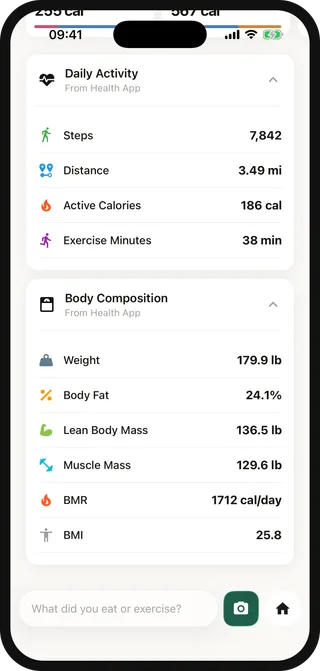
Fast meal logging. Photograph a plate and check the grams of rice, pasta or bread before saving — those are the foods that matter most for a runner.
Goals that move with training. Kaelo's adaptive goals take your logged intake and activity into account, so a long-run day and a rest day don't get the same target.
Setup checklist
- Estimate maintenance with the TDEE calculator, choosing the activity level that matches your weekly mileage.
- Connect Apple Health so runs and steps count automatically.
- Log meals for two weeks, paying attention to carbohydrate on long-run days.
- If you want to lose weight, aim for a small deficit — see how many calories to lose weight — and keep it in base training, not race weeks.
- Watch how runs feel alongside your average weight. Weight dropping while sessions get worse means you're eating too little.
When to get help
If you have missed or irregular periods, repeated stress fractures, or constant fatigue despite rest, talk to a doctor or a sports dietitian before cutting calories further.
Sources
Frequently asked questions
How many calories does running burn?
Roughly 1 kcal per kg of body weight per kilometre, so a 70 kg runner burns about 70 kcal per km, or about 700 kcal over 10 km. Pace changes this less than distance does.
Can I lose weight while training for a marathon?
Yes, slowly. Keep the deficit small (about 250–300 kcal a day), eat carbohydrate around long runs and hard sessions, and stop dieting in the last few weeks before the race.
How many carbs does a runner need?
The ACSM joint position statement gives about 5–7 g per kg a day for moderate training of around an hour a day, and 6–10 g per kg for 1–3 hours a day of moderate to high-intensity training.
What happens if runners don't eat enough?
Long-term low energy availability (called RED-S) can affect hormones, bone health, immunity, mood and performance. Missed periods, frequent injuries and constant fatigue are warning signs to see a doctor.
Should runners eat back the calories they burn?
On big training days, mostly yes, especially the carbohydrate. Running calorie estimates are more reliable than lifting estimates because distance drives most of the cost.
Log your next meal in seconds
Download KaeloiPhone and Android. Snap a meal, get calories and macros in seconds. Free trial on the yearly plan.
On your computer?Point your phone's camera at the code to install Kaelo.