
TDEE Calculator: How Many Calories Do You Burn a Day?
By Kaelo TeamUpdated
Your TDEE (total daily energy expenditure) is the number of calories you burn in a day, including exercise. Eat about that much and your weight stays roughly stable; eat less and you lose. Enter your details below for your TDEE, your resting burn (BMR), and two sensible weight-loss targets.
To find your TDEE: enter your sex, age, height, weight and activity level. The calculator estimates your resting burn with the Mifflin–St Jeor equation, then multiplies it by your activity factor.
Enter your details to see your TDEE.
What TDEE means
TDEE stands for total daily energy expenditure — every calorie your body uses in 24 hours. It has four parts:
| Part | What it is | Share of TDEE (typical) |
|---|---|---|
| BMR | Energy to keep you alive at rest | 60–70% |
| NEAT | Walking, standing, fidgeting, chores | 15–30% |
| Exercise | Planned workouts | 0–15% |
| TEF | Energy used digesting food | about 10% |
The surprise for most people is how small the exercise slice is. Daily movement (NEAT) usually matters more than the gym session, which is why step count is such a useful number to watch.
How this calculator works
We use the Mifflin–St Jeor equation, which in validation studies predicted resting energy expenditure more accurately than the older Harris–Benedict formula for most adults:
- Men: BMR = 10 × weight (kg) + 6.25 × height (cm) − 5 × age + 5
- Women: BMR = 10 × weight (kg) + 6.25 × height (cm) − 5 × age − 161
Then BMR is multiplied by an activity factor:
| Activity level | Factor | Looks like |
|---|---|---|
| Sedentary | 1.2 | Desk job, little exercise |
| Lightly active | 1.375 | Light exercise 1–3 days a week |
| Moderately active | 1.55 | Exercise 3–5 days a week |
| Very active | 1.725 | Hard exercise 6–7 days a week |
| Extra active | 1.9 | Physical job plus daily training |
Worked example: a 35-year-old woman, 165 cm, 70 kg, lightly active. BMR = 700 + 1,031 − 175 − 161 = 1,395 kcal. TDEE = 1,395 × 1.375 ≈ 1,920 kcal a day.
How to use your TDEE
- To maintain: eat close to your TDEE.
- To lose about 0.25 kg (0.5 lb) a week: eat about 275 kcal below it.
- To lose about 0.5 kg (1 lb) a week: eat about 550 kcal below it.
- To gain muscle: eat 200–300 kcal above it and train with weights.
Those deficits use the common rule of thumb that a kilogram of body fat stores about 7,700 kcal (3,500 kcal per pound). Research from the NIH shows real-world loss slows over time because your body adapts, so treat any goal date as an estimate — the calorie deficit calculator shows one with that caveat built in.
Make the estimate accurate for you
A formula can't see your actual metabolism. Your own data can:
- Eat your calculated target consistently for two to three weeks.
- Weigh yourself a few mornings a week and look at the weekly average, not single days.
- If your average weight is flat when you expected loss, your real TDEE is lower than estimated — drop 100–200 kcal. If you're losing faster than planned, add a little.
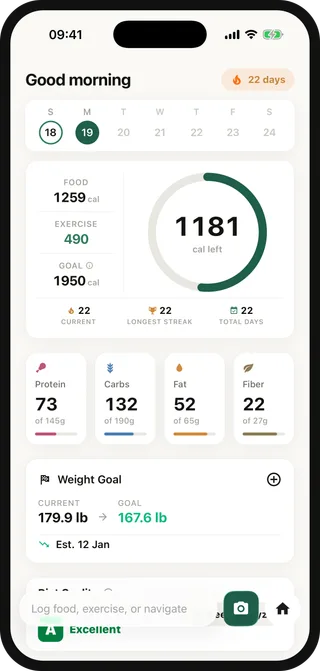
Kaelo's adaptive goals help with this: they learn from the intake and activity you log and adjust your daily calorie and macro targets.
When a TDEE calculator isn't the right tool
These formulas are built for healthy adults. They're less reliable if you're pregnant or breastfeeding, under 18, very muscular, or managing a medical condition — talk to a doctor or registered dietitian in those cases.
Sources
Frequently asked questions
How accurate is a TDEE calculator?
It's a starting estimate. The Mifflin–St Jeor equation predicts resting burn within about 10% for most adults, and the activity factor adds more uncertainty. Use the number for two to three weeks, track your weight, and adjust by 100–200 calories if the scale isn't doing what you expected.
What's the difference between TDEE and BMR?
BMR (basal metabolic rate) is what your body burns at complete rest — breathing, circulation, keeping warm. TDEE adds everything else: walking, work, exercise and digesting food. For most people TDEE is 1.2 to 1.9 times BMR.
Should I eat my TDEE to lose weight?
No — eating your TDEE maintains your weight. To lose about 0.5 kg (1 lb) a week you need a deficit of roughly 500 calories a day below your TDEE. The calculator shows that target for you.
Which activity level should I pick?
Most people overestimate. If you have a desk job and train three times a week, pick 'Lightly active' or 'Moderately active', not 'Very active'. When in doubt, choose the lower level and adjust after a few weeks of tracking.
Why does my TDEE go down as I lose weight?
A smaller body burns less energy at rest and moving around, and your metabolism adapts a little to eating less. Recalculate after every 4–5 kg (10 lb) you lose.