How Many Calories Should I Eat a Day to Lose Weight?
By Kaelo TeamUpdated
To lose weight, eat fewer calories than your body burns. For most adults that means about 300–550 calories a day below maintenance, which works out to roughly 0.25–0.5 kg (0.5–1 lb) a week. Your exact number depends on your size, age, sex and activity — in the worked examples below it's about 1,400 kcal a day for the women and 2,000–2,300 for the men.
 Download Kaelo
iPhone and Android. Snap a meal, get calories and macros in seconds. Free trial on the yearly plan.
On your computer?Point your phone's camera at the code to install Kaelo.
Step 1: Find your maintenance calories
Maintenance (your TDEE) is what you burn in a day. The TDEE calculator estimates it from your sex, age, height, weight and activity using the Mifflin–St Jeor equation.
Step 2: Subtract a deficit you can keep
| Goal pace | Daily deficit | Good for |
|---|---|---|
| 0.25 kg / 0.5 lb a week | ~280 kcal | Smaller people, the last few kilos, or a "sustainable forever" pace |
| 0.5 kg / 1 lb a week | ~550 kcal | Most people |
| 0.75–1 kg / 1.5–2 lb a week | ~830–1,100 kcal | Larger bodies with higher TDEEs, short phases |
The CDC notes that people who lose weight gradually and steadily — about 1–2 lb a week — are more likely to keep it off.
Worked examples
Calculated with the same formula as our calculators:
| Person | Maintenance | Lose 0.5 kg (1 lb) a week | Notes |
|---|---|---|---|
| Woman, 30, 165 cm, 70 kg, lightly active | ~1,950 kcal | ~1,400 kcal | |
| Woman, 45, 160 cm, 80 kg, sedentary | ~1,700 kcal | ~1,150 kcal | Below her resting burn (~1,410) — a 0.25 kg/week pace (~1,420 kcal) is the better choice |
| Man, 30, 180 cm, 85 kg, moderately active | ~2,840 kcal | ~2,290 kcal | |
| Man, 50, 175 cm, 100 kg, lightly active | ~2,540 kcal | ~1,990 kcal |
The second row shows why one number doesn't fit everyone: a smaller, less active person has less room for a deficit. Moving more — walking especially — makes room without eating less.
Step 3: Hit the number (this is the hard part)
A target only works if your log is honest. The usual leaks:
- Cooking oil and butter — about 100–120 kcal per tablespoon, often unlogged.
- Drinks — juice, sweet coffee, alcohol.
- "Bites" — tasting while cooking, kids' leftovers, office snacks.
- Portions — restaurant portions are bigger than they look.
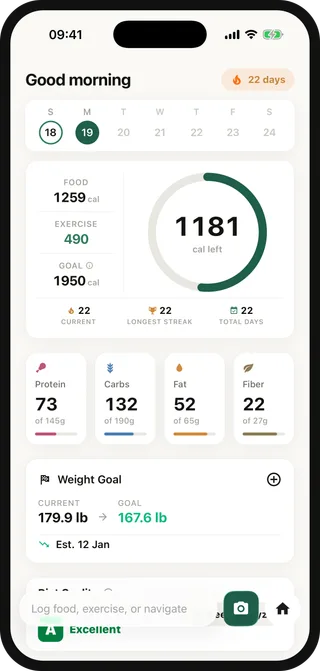
Logging every meal is the fix, and it needs to be fast enough that you keep doing it. A photo log takes seconds; just correct the portion of the calorie-dense part of the meal. See how to count calories from a photo.
Step 4: Adjust with real data after 2–3 weeks
Your calculated target is an estimate. After two to three weeks of consistent logging, look at your average weight (not daily readings):
- Losing about as planned: keep going.
- Not losing: you're probably eating more than logged, or burn less than estimated. Drop 100–200 kcal or add daily steps.
- Losing much faster than planned: add 100–200 kcal — fast loss is harder to sustain and costs more muscle.
Expect loss to slow over months. A lighter body burns less, so recalculate every 4–5 kg (10 lb).
Don't forget protein
In a deficit, protein protects muscle and keeps you fuller. Aim for roughly 1.2–1.6 g per kg of body weight a day while losing weight — see how much protein you need.
Sources
- CDC — Steps for Losing Weight
- Hall KD et al. Quantification of the effect of energy imbalance on bodyweight. The Lancet, 2011
- Mifflin MD et al. A new predictive equation for resting energy expenditure in healthy individuals. Am J Clin Nutr, 1990
- NIDDK Body Weight Planner (National Institutes of Health)
Frequently asked questions
Is 1,200 calories a day enough to lose weight?
It will cause weight loss for almost everyone, but for many people it's lower than necessary and hard to sustain, and it can make it difficult to get enough protein and nutrients. Calculate your own target first; if it's well above 1,200, there's no need to go that low.
How many calories should a woman eat to lose weight?
It depends on height, weight, age and activity. As an example, a 30-year-old woman who is 165 cm, 70 kg and lightly active maintains at about 1,950 kcal a day, so about 1,400 kcal would lose roughly 0.5 kg (1 lb) a week.
How many calories should a man eat to lose weight?
As an example, a 30-year-old man who is 180 cm, 85 kg and moderately active maintains at about 2,840 kcal a day, so about 2,290 kcal would lose roughly 0.5 kg (1 lb) a week.
Why am I not losing weight eating fewer calories?
The most common reasons are under-counting (oils, drinks, snacks and portions), an activity level set too high, and water retention hiding fat loss for a week or two. Track consistently for three weeks; if your average weight hasn't moved, lower your target by 100–200 kcal.
Should I count calories or macros?
Calories decide whether you lose weight. Protein decides how much of that loss is fat rather than muscle, and how full you feel. A good setup is a calorie target plus a protein target; carbs and fat can flex to preference.
Log your next meal in seconds
Download KaeloiPhone and Android. Snap a meal, get calories and macros in seconds. Free trial on the yearly plan.
On your computer?Point your phone's camera at the code to install Kaelo.