Calorie Deficit Calculator: Daily Target and Goal Date
By Kaelo TeamUpdated
A calorie deficit means eating fewer calories than you burn. This calculator finds your maintenance calories, subtracts a deficit for the pace you choose, and — if you enter a goal weight — estimates when you'll get there. It also warns you if the target falls below your resting metabolism.
To calculate your calorie deficit: enter your details, choose a pace (0.25–1 kg or 0.5–2 lb a week) and, optionally, a goal weight. You'll get a daily calorie target and an estimated goal date.
Enter your details to see your calorie target.
How the calculation works
- Maintenance calories. We estimate your resting burn with the Mifflin–St Jeor equation and multiply it by your activity factor — the same method as our TDEE calculator.
- Deficit. We subtract the daily deficit for your chosen pace, using the rule of thumb that 1 kg of body fat ≈ 7,700 kcal (1 lb ≈ 3,500 kcal):
| Pace | Daily deficit |
|---|---|
| 0.25 kg / 0.5 lb a week | about 280 kcal |
| 0.5 kg / 1 lb a week | about 550 kcal |
| 0.75 kg / 1.5 lb a week | about 830 kcal |
| 1 kg / 2 lb a week | about 1,100 kcal |
- Goal date. If you enter a goal weight, we divide the energy you need to lose by your daily deficit. This is a straight-line estimate — see below for why reality is slower.
- Safety check. If your target is below your estimated resting metabolism (BMR), we tell you. That's a sign the pace is too aggressive for your size.
Why real weight loss is slower than the maths
The 7,700 kcal rule treats your body like a fixed battery. It isn't. As you lose weight you burn less — a smaller body costs less to run, and you move a little less without noticing. Researchers at the NIH built a dynamic model (the Body Weight Planner) because the simple rule overestimates long-term loss. Practically:
- Expect the first two weeks to look faster than planned (water and stored carbohydrate).
- Expect months two to four to look slower than planned.
- Recalculate your target every 4–5 kg (10 lb) lost.
Picking a pace you'll actually keep
The best deficit is the one you can keep for months. A few patterns that help:
- Start gentle. 0.25–0.5 kg a week rarely makes people miserably hungry.
- Keep protein high. Higher protein intake helps preserve muscle and keeps you fuller in a deficit — see how much protein you need.
- Lift weights. Resistance training tells your body to keep muscle while you lose fat.
- Plan maintenance breaks. A week at maintenance every couple of months is fine and often helps adherence.
The hard part: actually hitting the number
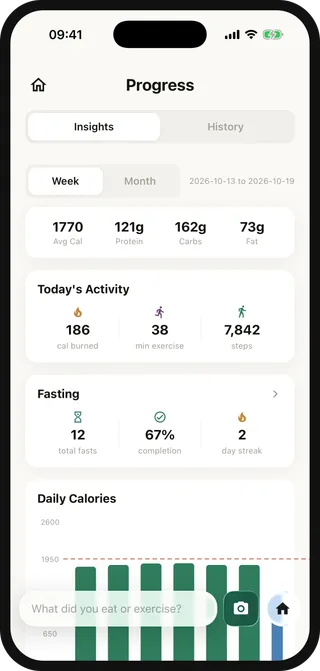
A target only works if you know what you ate. Most people underestimate their intake — in a classic study, participants who believed they ate under 1,200 kcal were actually eating about twice as much as they reported. Logging every meal, including oils and drinks, is what closes that gap. Kaelo lets you log a meal from a photo, then correct the portion in grams so the estimate matches your plate.
Sources
- CDC — Steps for Losing Weight
- Hall KD et al. Quantification of the effect of energy imbalance on bodyweight. The Lancet, 2011
- Mifflin MD et al. A new predictive equation for resting energy expenditure in healthy individuals. Am J Clin Nutr, 1990
- NIDDK Body Weight Planner (National Institutes of Health)
- Lichtman SW et al. Discrepancy between self-reported and actual caloric intake and exercise in obese subjects. N Engl J Med, 1992
Frequently asked questions
How big should my calorie deficit be?
For most people, 300–550 calories a day below maintenance — about 0.25–0.5 kg (0.5–1 lb) a week. The CDC notes that people who lose about 1–2 lb a week are more likely to keep it off than people who lose faster. Larger deficits are harder to sustain and make it harder to keep muscle.
Is a 1,000-calorie deficit safe?
It can be for people with a lot of weight to lose and a high TDEE, but for most people it pushes intake below what's sustainable or nutritionally adequate. If the calculator shows your target below your resting metabolism, choose a slower pace or check with a doctor or dietitian.
Why am I not losing weight in a calorie deficit?
Usually because the deficit is smaller than you think: portions are underestimated, cooking oils and drinks go unlogged, or your activity level was set too high. Water retention can also hide fat loss for one to two weeks. Track consistently for three weeks before changing anything.
Should I eat back calories burned from exercise?
If your activity level already includes your workouts, no — they're counted. If you chose 'Sedentary' and track workouts separately, eating back about half of the estimated exercise calories is a reasonable compromise, because fitness trackers often overestimate burn.
How accurate is the goal date?
It's an estimate that assumes a constant deficit. In reality weight loss slows as you get lighter and your body adapts, so most people take somewhat longer than a simple calculation predicts. Recalculate every 4–5 kg (10 lb).