How Much Protein Do You Need Per Day? By Goal and Body Weight
By Kaelo TeamUpdated
Most adults need at least 0.8 g of protein per kg of body weight a day (0.36 g per lb) — that's the official minimum. If you're losing weight, about 1.2–1.6 g/kg helps protect muscle and control hunger. If you lift and want to build muscle, research points to about 1.6 g/kg, with up to 2.2 g/kg as a safe upper target.
 Download Kaelo
iPhone and Android. Snap a meal, get calories and macros in seconds. Free trial on the yearly plan.
On your computer?Point your phone's camera at the code to install Kaelo.
Protein needs by goal
| Goal | Grams per kg per day | Grams per lb per day |
|---|---|---|
| Minimum for healthy adults (RDA) | 0.8 | 0.36 |
| Adults over 65 | 1.0–1.2 | 0.45–0.55 |
| Losing weight | 1.2–1.6 | 0.55–0.73 |
| Building muscle (with strength training) | 1.6 (up to 2.2) | 0.73 (up to 1.0) |
The RDA is set to prevent deficiency in nearly everyone — it's a floor, not an optimum for active people. The PROT-AGE expert group recommends older adults aim higher, at 1.0–1.2 g/kg, to help preserve muscle with age.
Daily protein by body weight
| Body weight | Minimum (0.8 g/kg) | Losing weight (1.2–1.6 g/kg) | Building muscle (1.6–2.2 g/kg) |
|---|---|---|---|
| 55 kg / 121 lb | 44 g | 66–88 g | 88–121 g |
| 65 kg / 143 lb | 52 g | 78–104 g | 104–143 g |
| 75 kg / 165 lb | 60 g | 90–120 g | 120–165 g |
| 85 kg / 187 lb | 68 g | 102–136 g | 136–187 g |
| 95 kg / 209 lb | 76 g | 114–152 g | 152–209 g |
Why protein matters more when you're in a deficit
When you eat less than you burn, your body draws on fat and muscle. Higher protein intake, especially with resistance training, shifts that loss toward fat. Protein is also the most filling macronutrient, which makes a deficit easier to stick to, and it costs more energy to digest than carbs or fat.
How to hit your target without living on shakes
Spread it out: about 20–40 g per meal across three or four meals is easier than one huge serving, and it's what the International Society of Sports Nutrition recommends.
Protein per 100 g of common foods (USDA values, cooked):
| Food | Protein | Calories | Protein per 100 kcal |
|---|---|---|---|
| Chicken breast | 31 g | 165 | ~19 g |
| Tuna | 30 g | 184 | ~16 g |
| Salmon | 20 g | 208 | ~10 g |
| Boiled egg | 12.6 g | 155 | ~8 g |
| White rice | 2.7 g | 130 | ~2 g |
"Protein per 100 kcal" is the useful column when you're cutting: lean poultry and fish give you a lot of protein for few calories, while eggs and salmon bring more fat along with it (which is fine — they're just less calorie-efficient).
Easy 30 g servings: about 100 g of cooked chicken breast or tuna; about 150 g of cooked salmon; about five boiled eggs.
Track it, don't guess it
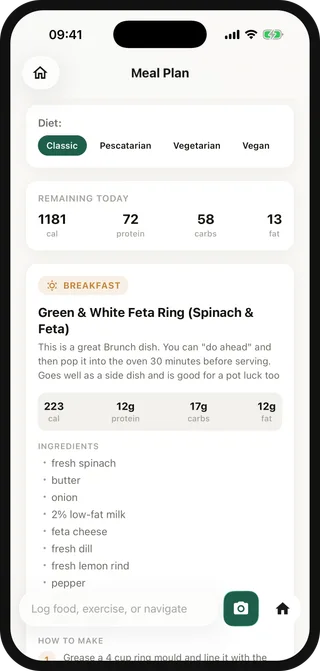
Most people who think they eat "plenty of protein" are well under 1.2 g/kg once they log a few days. Kaelo shows protein next to calories for every meal you log — from a photo or a barcode — so you can see by lunchtime whether you're on track. Pair this with your calorie target from the TDEE calculator.
Sources
- National Academies — Dietary Reference Intakes for Energy, Carbohydrate, Fiber, Fat, Fatty Acids, Cholesterol, Protein, and Amino Acids
- Morton RW et al. A systematic review, meta-analysis and meta-regression of the effect of protein supplementation on resistance training-induced gains in muscle mass and strength. Br J Sports Med, 2018
- Jäger R et al. International Society of Sports Nutrition Position Stand: protein and exercise. J Int Soc Sports Nutr, 2017
- Leidy HJ et al. The role of protein in weight loss and maintenance. Am J Clin Nutr, 2015
- Bauer J et al. Evidence-based recommendations for optimal dietary protein intake in older people (PROT-AGE). J Am Med Dir Assoc, 2013
- USDA FoodData Central
Frequently asked questions
How much protein do I need to build muscle?
About 1.6 g per kg of body weight a day, combined with resistance training. A large 2018 meta-analysis found gains in muscle plateaued around that intake on average, with some people benefiting up to about 2.2 g/kg.
How much protein do I need to lose weight?
Around 1.2–1.6 g per kg of body weight a day. Higher protein in a calorie deficit helps preserve lean mass and improves fullness, which makes the deficit easier to keep.
Can you eat too much protein?
For healthy adults, intakes up to about 2 g/kg are well studied and considered safe. People with kidney disease need individual advice from their doctor, as protein needs and limits differ.
How much protein should I eat per meal?
About 20–40 g per meal (roughly 0.25–0.4 g/kg) spread across three or four meals is a practical way to reach a daily target and is what sports nutrition guidance recommends.
Should I use my current weight or goal weight?
If you carry a lot of excess body fat, using your goal weight (or a target weight) gives a more realistic number; using current weight can overestimate. If you're near a healthy weight, current weight is fine.
Log your next meal in seconds
Download KaeloiPhone and Android. Snap a meal, get calories and macros in seconds. Free trial on the yearly plan.
On your computer?Point your phone's camera at the code to install Kaelo.