Are AI Calorie Counting Apps Accurate? What the 2026 NIH Test Found
By Kaelo TeamUpdated
AI calorie apps are useful but not precise. In a 2026 NIH test of MyFitnessPal, Lose It!, Cal AI and Appediet, all four under-counted meal calories by about 250–345 kcal on average, mostly by missing fat. Carbohydrate estimates were more consistent. Used with a few corrections, AI logging is accurate enough to steer weight loss — used blindly, it makes you think you're in a deficit when you aren't.
 Download Kaelo
iPhone and Android. Snap a meal, get calories and macros in seconds. Free trial on the yearly plan.
On your computer?Point your phone's camera at the code to install Kaelo.
What the NIH test did
Researchers at the National Institute of Diabetes and Digestive and Kidney Diseases (part of the NIH) had something most app reviews don't: meals with known calories. As part of a larger inpatient diet study, every ingredient was weighed in a metabolic kitchen. They took standardised photos of 102 of those meals and ran them through four apps — MyFitnessPal, Lose It!, Cal AI and Appediet — then compared the apps' estimates with the true values.
The findings, presented at NUTRITION 2026 in July:
- Calories: all four apps under-estimated, by about 250–345 kcal per meal on average.
- Fat: under-estimated by about 30 g per meal — the main source of the calorie gap.
- Carbohydrates: estimated more consistently than other nutrients.
- Keto meals: early results from 200+ more meals suggest apps struggle more with high-fat, low-carb meals.
The researchers' advice was practical: if you don't adjust portions or enter amounts, take the numbers with a grain of salt — your real intake is probably higher.
Why AI misses fat
Fat is the most calorie-dense nutrient (9 kcal per gram versus 4 for protein and carbs), and it's the hardest to see:
- Oil soaks into rice, noodles and vegetables.
- Butter melts into sauces.
- Cheese and mayonnaise hide inside sandwiches and wraps.
- Fatty cuts of meat look like lean cuts in a photo.
Thirty missed grams of fat is 270 kcal — the whole gap, in roughly two tablespoons of oil.
What a 300-calorie miss means for weight loss
If you plan a 500 kcal daily deficit and your logs under-count by 300 kcal across the day, your real deficit is only about 200 kcal. Instead of losing roughly 0.5 kg (1 lb) a week, you'd lose under half that — and conclude that "calorie counting doesn't work".
That's the real risk of inaccurate AI logging: not the error itself, but drawing the wrong conclusion from it.
How to make any AI calorie app accurate enough
- Correct the portion of the calorie-dense item — rice, pasta, noodles, meat, cheese. That's where errors are largest in absolute calories.
- Add cooking fat manually. One tablespoon of oil ≈ 120 kcal; one tablespoon of butter ≈ 100 kcal.
- Log sauces and drinks separately. They're nearly invisible in photos.
- Use the barcode for packaged food. A label beats a photo every time.
- Calibrate with a scale now and then. Weigh your usual rice or pasta portion once; you'll eyeball it better forever.
- Let your weight trend check the log. If two to three weeks of logging at a deficit doesn't move your average weight, assume you're under-logging by 200–300 kcal and adjust.
So should you trust AI calorie counting?
Trust it for speed and consistency, not for precision. Logging every meal in seconds — and correcting the two or three items that matter — is more accurate in practice than meticulous logging you give up on after a week. Human estimates are biased too: in a 1992 New England Journal of Medicine study, people who reported very low intakes were eating far more than they recorded.
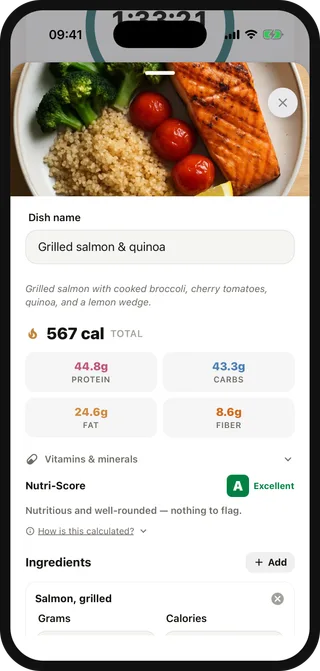
We built Kaelo around that reality: every scan can be edited in grams, packaged foods can be scanned by barcode, and adaptive goals adjust your targets from what you actually log and how active you are. For the full method, see how to count calories from a photo.
Sources
- NIH / American Society for Nutrition — Photo-based calorie-tracking apps may underestimate energy in meals (NUTRITION 2026)
- Lichtman SW et al. Discrepancy between self-reported and actual caloric intake and exercise in obese subjects. N Engl J Med, 1992
- Hall KD et al. Quantification of the effect of energy imbalance on bodyweight. The Lancet, 2011
Frequently asked questions
Which AI calorie app is the most accurate?
There's no independent, peer-reviewed ranking yet. The 2026 NIH abstract didn't publish per-app error figures for photo estimates; it reported that all four apps tested under-counted. Accuracy depends more on how you use the app — checking portions and adding oils — than on which app you choose.
Was Kaelo tested in the NIH study?
No. The study tested MyFitnessPal, Lose It!, Cal AI and Appediet. Kaelo uses the same kind of technology, so we assume the same limits apply and built portion editing in grams into every scan for that reason.
Do AI calorie apps overestimate or underestimate?
On average they underestimate, according to the 2026 NIH test — by about 250–345 calories per meal, with fat under-counted by about 30 g. They did worse on high-fat, low-carb (ketogenic) meals.
Is the study peer-reviewed?
Not yet. It was presented as a conference abstract at NUTRITION 2026, the American Society for Nutrition's annual meeting. Treat the exact numbers as preliminary, though the direction — apps under-count fat — matches what dietitians see in practice.
Are calorie counts on food labels accurate?
Not exactly either. US labeling rules allow some variance between the declared and actual calories. Labels are still far more reliable than guessing, and for packaged foods a barcode scan is usually better than a photo.
Log your next meal in seconds
Download KaeloiPhone and Android. Snap a meal, get calories and macros in seconds. Free trial on the yearly plan.
On your computer?Point your phone's camera at the code to install Kaelo.